

Royal Render and the Power of Hybrid Cloud Rendering
In today’s rapidly evolving digital content landscape, studios face increasing demands for higher visual fidelity, faster turnaround times, and greater project complexity. At Royal Render, we have seen firsthand how these pressures challenge traditional on-premise pipelines. As workflows grow heavier and deadlines become tighter, relying exclusively on local infrastructure often introduces bottlenecks that hinder creativity and productivity. This is why hybrid cloud rendering, an intelligent blend of on-premise and cloud-based compute, has emerged as one of the most effective solutions for modern studios.
Hybrid cloud rendering provides the flexibility to scale resources dynamically, allowing artists to operate without the constraints of hardware limits. With Royal Render’s orchestration and automation, studios can seamlessly extend their existing render farm into the cloud only when needed. This eliminates the need to maintain excessive on-premise hardware that sits idle during slower periods. Instead, studios pay for cloud capacity only during peak times, optimising budgets without compromising performance.
Another key advantage is workload prioritisation and routing. Royal Render’s rule-based job distribution makes it easy to direct specific tasks, such as simulations, denoising, or final frames, to the environment best suited for them. Heavy, time-sensitive jobs can burst to the cloud, while steady baseline workloads continue running on local nodes. This hybrid approach not only reduces render times but also smooths production scheduling, ensuring teams meet deadlines without sacrificing quality.
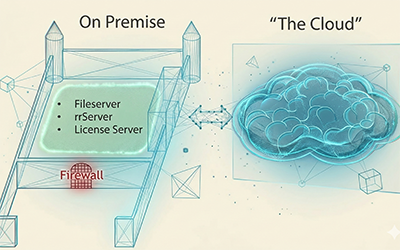
Beyond performance and cost efficiency, hybrid cloud rendering enhances pipeline resilience. Hardware failures, sudden demand spikes, or unexpected client revisions can derail a production running solely on local resources. Through hybrid workflows, Royal Render ensures you always have a fallback. If local capacity becomes strained, rendering can automatically shift to the cloud, minimising disruption and maintaining studio momentum. This redundancy adds an important layer of reliability to any ambitious production pipeline.
Hybrid cloud strategies also benefit from Royal Render’s built-in security and management features. Asset transfer, access control, and environment configuration are handled with security in mind, ensuring that sensitive project data is protected whether running on-premise or in the cloud. Centralised monitoring provides full visibility across all job executions, enabling production supervisors and TDs to track resource usage, costs, and performance from a single interface.
From an innovation standpoint, hybrid cloud rendering empowers studios to expand their creative capabilities without massive upfront investments. Teams can iterate faster, explore higher-resolution content, and take on more ambitious projects. Smaller studios gain access to the kind of compute power once reserved for major production houses, levelling the creative playing field. Larger studios gain the operational agility they need to stay competitive in a global production environment.
At Royal Render, we believe hybrid cloud rendering is not simply an infrastructure choice, it is a strategic evolution. By combining the stability of on-premise systems with the elasticity of cloud computing, studios achieve the best of both worlds: efficiency, scalability, and creative freedom. As production demands continue to rise, hybrid cloud workflows will be at the core of how modern studios deliver groundbreaking content faster and more cost-effectively than ever before.